





💸⛄️. Does the mere thought of your debt make your chest tighten? You’re not alone. Staring at a mountain of student loans, credit card balances, and car payments can feel paralyzing. You know you need to pay it off, but the math seems overwhelming, and the finish line feels decades away. What if there was a method that ignored conventional financial wisdom and instead hacked your brain’s psychology to build unstoppable momentum? A method so simple it almost seems too good to be true.
Enter the Debt Snowball Method. Popularized by personal finance expert Dave Ramsey, this strategy isn’t about interest rates or complex calculations. It’s about human behavior, motivation, and the profound power of quick wins. It’s the systematic way to create a tangible sense of progress and turn the slog of debt repayment into a series of empowering victories.
Why the Math-First Approach Often Fails 🧮
Logically, you should pay off debts with the highest interest rates first (the Debt Avalanche method). This saves the most money on interest over time. So why do so many people fail at it?
Because debt payoff isn’t a purely mathematical problem; it’s an emotional and behavioral one. When you attack a large, high-interest debt first, progress can feel agonizingly slow for months or even years. That lack of visible momentum kills motivation, leading to discouragement and relapse into old spending habits.
The Debt Snowball Method flips the script. It prioritizes psychological wins over financial optimization, recognizing that motivation is the fuel that will get you to the finish line.

The Snowball Analogy: How a Tiny Start Creates an Avalanche
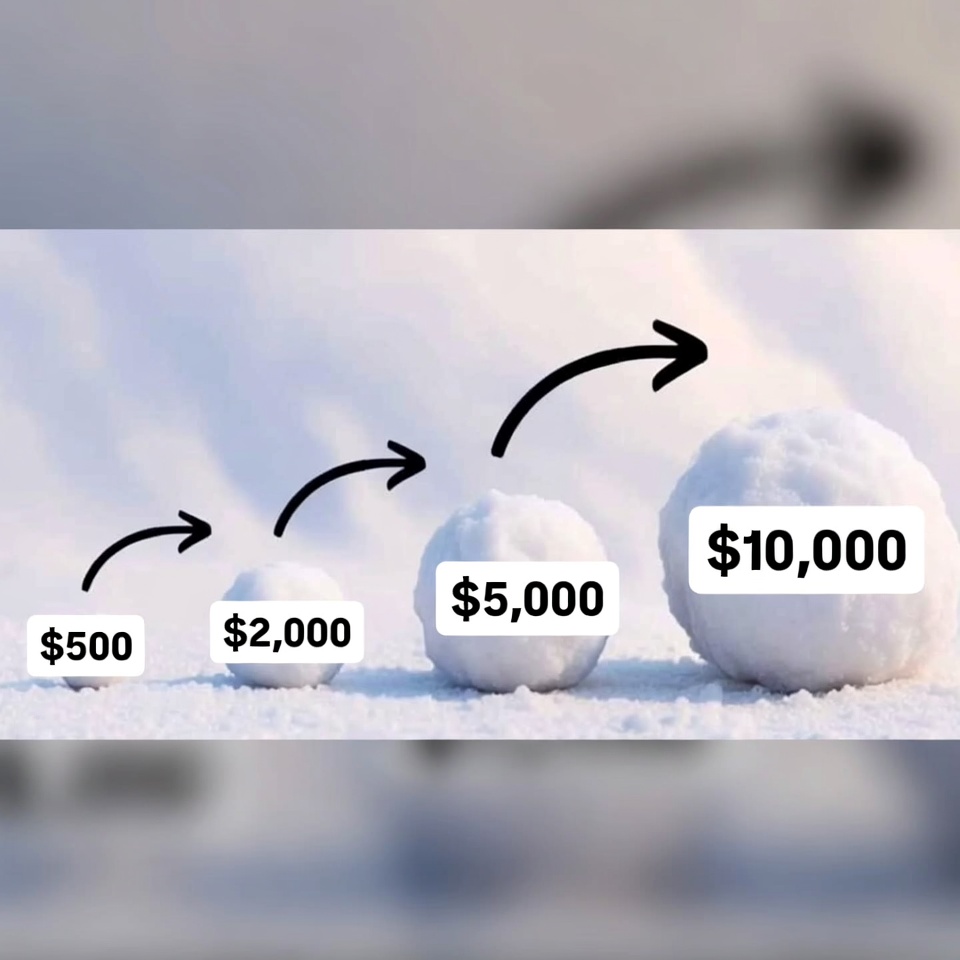
Imagine rolling a small snowball down a hill. It starts slowly, picking up just a little snow. But with each revolution, it grows larger and gains momentum, eventually becoming a powerful, unstoppable force.
The Debt Snowball applies this same physics to your finances:
- You start with a small, manageable win (paying off your smallest debt).
- That success builds momentum and confidence.
- You roll the money you were using on that paid-off debt into the next one, making your payment snowball larger.
- Repeat. Each debt gets knocked out faster than the last, building incredible speed and psychological power.
Read also: Cashback Apps Are Good, But This Combined Offers Trick Is Genius
Your Step-by-Step Snowball Blueprint
Step 1: The Inventory – List Your Debts from Smallest to Largest
Grab all your statements. Create a simple list, ordering debts by their current total balance owed, from the smallest to the largest. Ignore the interest rates for this method.
Example List:
- Department Store Card: $500 (Min. payment: $25)
- Credit Card A: $2,000 (Min. payment: $60)
- Personal Loan: $5,000 (Min. payment: $150)
- Car Loan: $10,000 (Min. payment: $300)
Step 2: The Minimum Foundation – Make Minimum Payments on Everything
This is non-negotiable. You must maintain at least the minimum payment on every single debt to avoid fees and credit damage.
Step 3: The Snowball Starter – Attack the Smallest Debt with Everything You’ve Got
Scrutinize your budget. Where can you find an extra $50, $100, or $200 per month? (Think subscription cuts, dining out, a temporary side hustle). Pour every extra dollar you can find toward your smallest debt (the $500 store card), while still making minimums on the others.
Step 4: The Roll & Grow – Celebrate, Then Redirect the Cash Flow
Once that first debt is GONE, celebrate that win! Then, take the full amount you were paying toward it (the $25 minimum + your extra $100 = $125) and add it to the minimum payment of your next debt (Credit Card A).
Now, instead of paying $60, you’re paying $185 toward Credit Card A. Your snowball payment just got bigger. This is the magic.
Step 5: The Momentum – Repeat Until Debt-Free
You repeat the process. When Card A is gone, you roll its entire payment ($185 + the $60 min = $245) onto the Personal Loan payment of $150, attacking it with $395 per month. The process accelerates dramatically with each debt you eliminate.
Tools to Track Your Snowball
- The Classic Spreadsheet: Create columns for Debt Name, Total Balance, Minimum Payment, and Snowball Payment. Update it monthly. Watching the numbers drop is incredibly satisfying.
- Debt Payoff Apps: Use apps like Undebt.it or Debt Payoff Planner. They can calculate your snowball timeline and show you your debt-free date, a powerful motivator.
- The Visual Tracker: Draw a simple thermometer or a series of boxes for each debt on your fridge. Color them in as you pay down balances. Physical visibility reinforces commitment.
Answering the Big Objection: But the Interest Rates!
Yes, mathematically, you might pay a bit more in interest with the Snowball versus the Avalanche. But finance is 20% math and 80% behavior. The Snowball method offers something priceless that a spreadsheet can’t calculate: consistent, early reinforcement.
Paying off that first $500 debt in just 3 months gives you a taste of freedom. It proves you can do it. That victory fuels the discipline needed to tackle the $2,000 debt. For most people, the behavioral success of the Snowball leads to faster overall debt elimination than the mathematically optimal method they can’t stick with.

Your First Move: The 5-Minute Start
You don’t need a perfect budget to begin. You just need to start the list.
- Right now, open a notes app or grab a piece of paper.
- Write down all your non-mortgage debts, from smallest total balance to largest.
- Circle the very first one on that list.
That circled debt is now your sole financial target. Your mission is to find just one extra dollar today to put toward it. You’ve just started your snowball. The momentum begins with that single, conscious decision.
The Debt Snowball Method isn’t a secret; it’s a system. It trades complex math for simple action, and despair for momentum. Your debt didn’t appear overnight, and it won’t vanish overnight. But by focusing on the smallest battle first, you train yourself to win the war. Start your snowball rolling today—its power will surprise you.











 English
  Deutsch
  Français
  Italiano
  Español
  Čeština
  Polski
  Bahasa Indonesia
  Türkçe
  Svenska
  Українська
  Português do Brasil