






We’ve all been there. That important email sits in your inbox, staring back at you. The pile of dishes in the sink seems to grow every time you glance at it. You know you should start that report, go for a run, or finally organize that closet, but a heavy, invisible force holds you back. This isn’t just laziness; it’s the mental weight of starting—the dreaded enemy known as procrastination.
What if you had a secret weapon, a simple psychological trick so powerful it could shatter that resistance in seconds? You do. It’s called the Two-Minute Rule, and it’s about to change your life.
What Exactly Is the Two-Minute Rule?
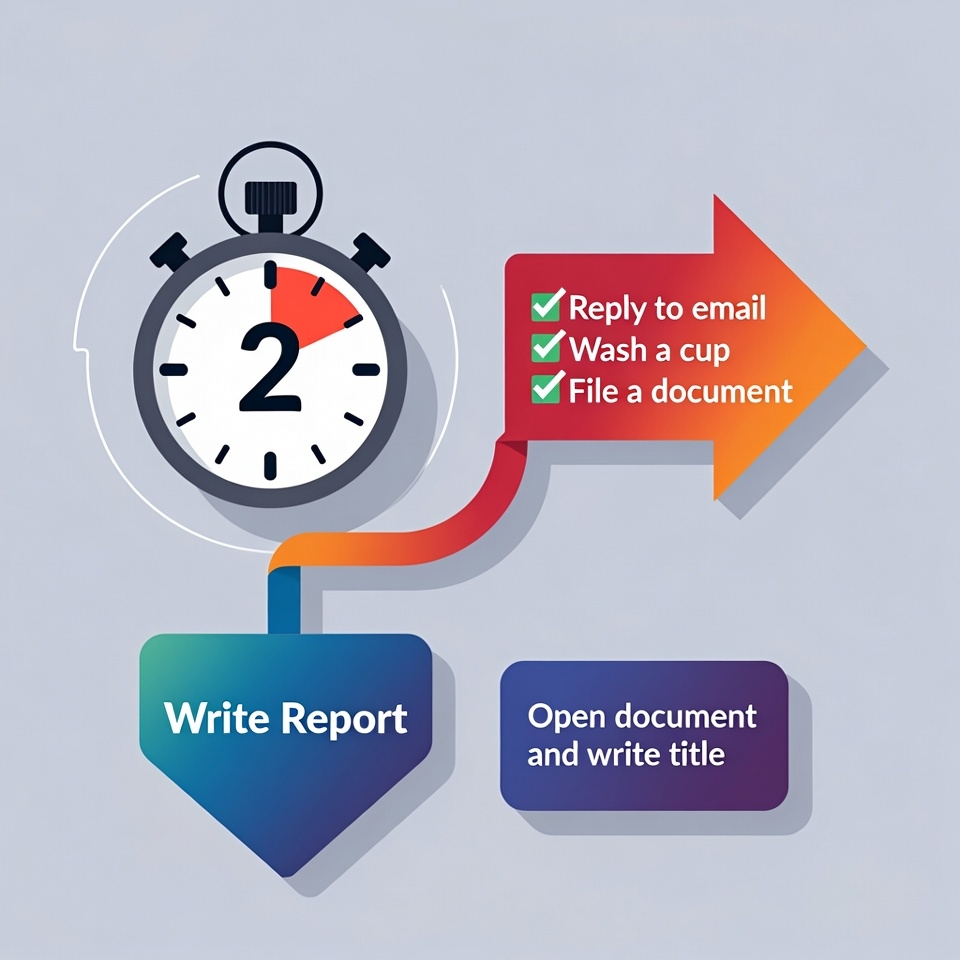
The Two-Minute Rule is a core concept from David Allen’s legendary productivity book, Getting Things Done (GTD). Its beauty lies in its stunning simplicity. The rule has two parts:
- If a task takes less than two minutes to complete, do it immediately.
- If a task will take longer than two minutes, start it by doing a two-minute version of it.
The first part is a brilliant hack for clearing life’s small but accumulating clutter. The second part is the real magic key that unlocks motivation and builds unstoppable momentum on bigger projects. It’s not about finishing; it’s about starting.
Read also: Stress-Busting Desk Exercises
Why Your Brain Loves This Rule: The Psychology of Starting
Procrastination isn’t a character flaw; it’s a brain glitch. Our primitive brain is wired to conserve energy and avoid potential discomfort. A big, undefined task feels like a threat—it’s uncertain, difficult, and daunting. This triggers the amygdala, the brain’s alarm bell, making us seek the immediate, easy relief of distractions (hello, social media scroll!).
The Two-Minute Rule bypasses this entire system.
- It Makes the Task Non-Threatening: Two minutes is too short to be scary. Your brain doesn’t have time to mount a full-scale resistance. “Just two minutes” feels trivial, so the amygdala stays quiet.
- It Harnesses the Power of the Zeigarnik Effect: This psychological principle states that people remember uncompleted or interrupted tasks better than completed ones. Once you start a task, even for two minutes, your brain gets hooked on finishing it. It creates a cognitive tension that drives you to see it through.
- It Builds Momentum: Newton’s first law of motion applies to productivity too: an object at rest stays at rest, and an object in motion stays in motion. The Two-Minute Rule is the gentle push that gets you from a state of rest into a state of motion. Starting is almost always the hardest part.
How to Apply the Rule: From Theory to Life-Changing Practice
Let’s move from concept to action. Here’s how to deploy the Two-Minute Rule across different areas of your life.
Part 1: The “Do It Now” Principle (For sub-2-minute tasks)
This is your secret weapon against clutter and mental load. The goal is to prevent small tasks from piling up into an overwhelming mountain.
Examples:
- Email: Reply to a short email, archive a read message, or unsubscribe from a spam list.
- Home: Wash your coffee mug, put a book back on the shelf, hang up your coat, or take out one bag of trash.
- Work: Quickly approve a request, send a calendar invite, or jot down a meeting note.
- Digital: Delete 10 old photos from your phone, close 5 unused browser tabs, or update one line in your digital profile.
By consistently applying this, you clear the “static” from your mind and environment, freeing up mental RAM for more important work.

Part 2: The “Just Start” Principle (For large, daunting tasks)
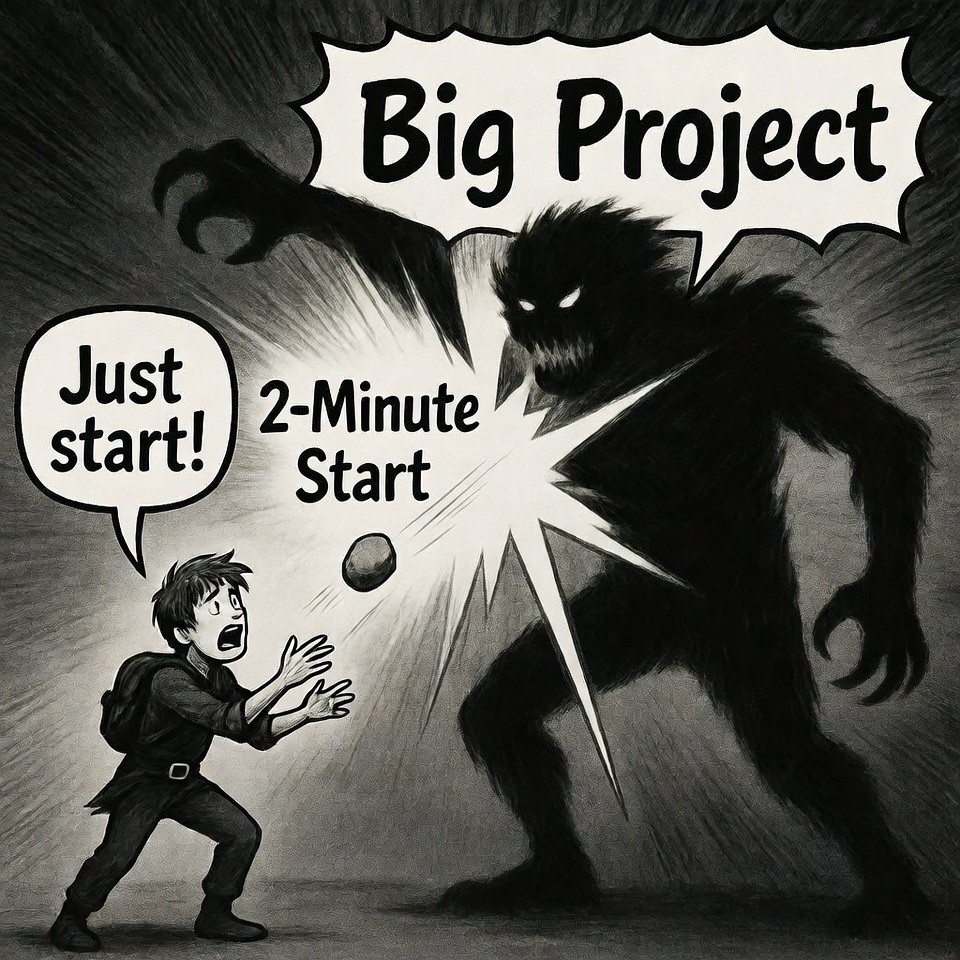
This is where the rule transforms from a tidy-up trick into a productivity powerhouse. You’re not committing to the whole project; you’re just committing to the first two minutes.
The Magic of “The Next Action”: The key is to define the very next physical action. Don’t write down “Write report.” That’s a project. The next action is “Open a new Word document and name it.” or “Find three sources for the introduction.”
Examples in Action:
- Task: “Go for a 5k run.”
2-Minute Version: “Put on my running shoes and step outside.”
- Task: “Write a 2000-word blog post.”
2-Minute Version: “Open a blank document and write the headline and three bullet points for the outline.”
- Task: “Clean the entire garage.”
2-Minute Version: “Take one bag of trash out to the bin.”
- Task: “Learn Spanish.”
2-Minute Version: “Open the Duolingo app and complete one lesson.”
Notice what happens. Once your shoes are on, you’ll likely think, “Well, I might as well walk to the end of the street.” Once you have three bullet points, your mind will start filling in the fourth. You’ve broken the initial inertia.
Advanced Tips: Making the Two-Minute Rule a Habit
- Combine it with Habit Stacking: Tie your two-minute start to an existing habit. “After I pour my morning coffee (existing habit), I will open my thesis document and write one sentence (new 2-minute habit).”
- Use a Physical Timer: The visual and auditory cue of a timer (like on your phone) creates a clear boundary. When it goes off, you have permission to stop, but often, you’ll want to continue.
- Celebrate the Start, Not Just the Finish: Train your brain to get a dopamine hit from starting. Acknowledge your win after those two minutes with a mental “Yes, I did it!”
The Ripple Effect: A Life with Less Procrastination
The Two-Minute Rule does more than just check off tasks. It fundamentally rewires your relationship with work and responsibility. You stop seeing yourself as a procrastinator and start seeing yourself as someone who gets things done. The constant, low-grade anxiety of unfinished business begins to fade, replaced by a sense of control and accomplishment.
It’s a small commitment with a colossal return. The barrier to entry is laughably low. You don’t need more willpower, a new app, or a complex system. You just need two minutes.
So, what are you waiting for? Don’t plan to clean the whole house. Just set a timer for two minutes and start with the dishes. Don’t stress about the perfect workout. Just put on your shoes.
Your two minutes start now.










 English
  Deutsch
  Français
  Italiano
  Español
  Čeština
  Polski
  Bahasa Indonesia
  Türkçe
  Svenska
  Українська
  Português do Brasil