





You start the day with a meticulously written to-do list. It’s long, it’s detailed, and just looking at it gives you a slight sense of dread. By 3 PM, you’ve been busy all day—answering emails, putting out fires, attending meetings—but the most important tasks on your list remain untouched, now accompanied by a heavy layer of guilt.
Sound familiar? The problem isn’t you; it’s your system. A standard to-do list is a collection of tasks without a hierarchy. It treats everything as equally urgent and important, which is a recipe for stress and reactive work.
The solution isn’t a better notepad or a new app. It’s a decision-making framework used by world leaders and top executives: The Eisenhower Matrix.
What is the Eisenhower Matrix?
The Eisenhower Matrix, also known as the Urgent-Important Matrix, is a simple but powerful tool for prioritizing your tasks. It was popularized by President Dwight D. Eisenhower, who famously said, “What is important is seldom urgent, and what is urgent is seldom important.”
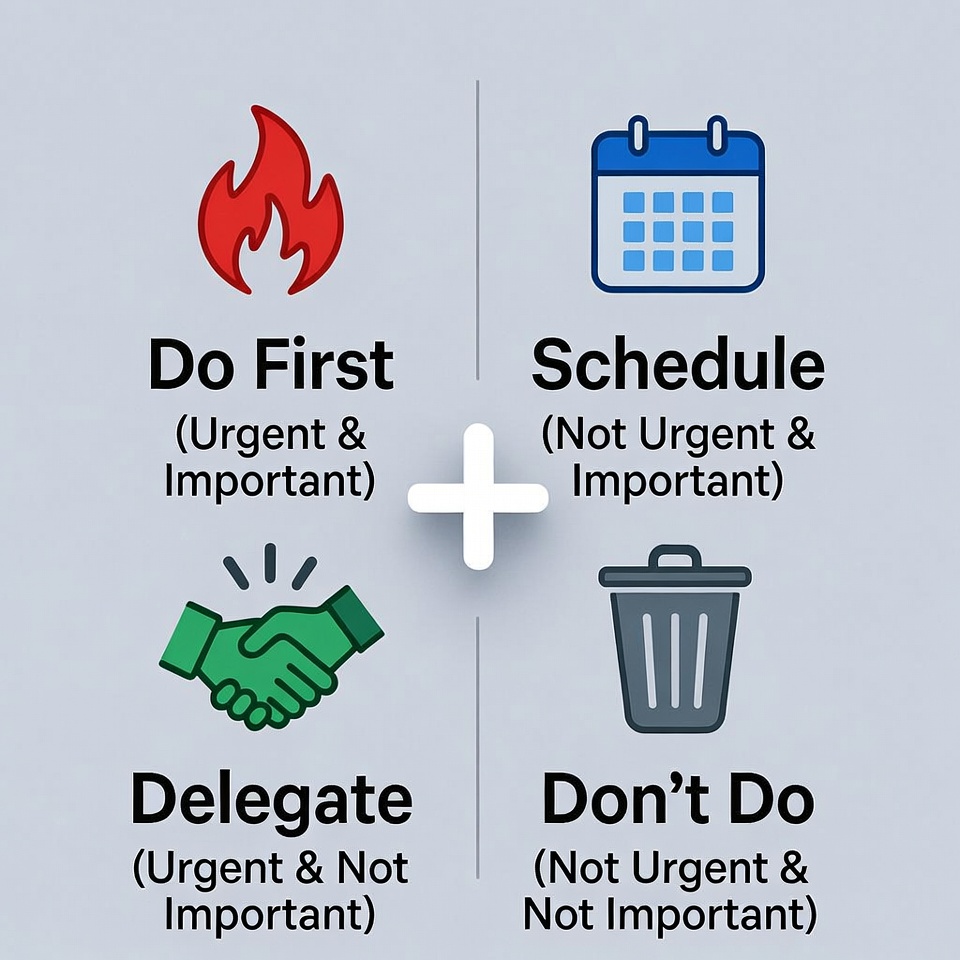
The matrix forces you to categorize every task along two axes:
- Is it Urgent? (Requires immediate attention, time-sensitive)
- Is it Important? (Contributes to your long-term goals, mission, and values)
By plotting these, you create four distinct quadrants, each with a clear action plan.
Read also: Detox Your Social Media Feed
Deconstructing the Four Quadrants: Your New Action Plan
Let’s break down each quadrant and what to do with the tasks you place there.
Quadrant 1: DO – Urgent and Important 🚨
These are the crises and deadlines. They demand your immediate attention and are critical to your goals.
- Examples: A project with a same-day deadline, a critical system failure, a family emergency.
- Action: Do these tasks immediately. The goal of good time management is to shrink this quadrant as much as possible, as living here leads to burnout.

Quadrant 2: SCHEDULE – Important, but Not Urgent ⏳
This is the quadrant of growth and strategy. These tasks are crucial for your long-term success but don’t scream for attention.
- Examples: Strategic planning, exercise, learning a new skill, building relationships, major project work.
- Action: Schedule dedicated time in your calendar to focus on these tasks. This is the most critical quadrant for high achievers. Neglecting it means you’ll always be a victim of Quadrant 1.

Quadrant 3: DELEGATE – Urgent, but Not Important 📤
These tasks are time-sensitive but don’t contribute significantly to your own goals. They are often about other people’s priorities.
- Examples: Many emails, phone calls, and meetings; minor requests from colleagues.
- Action: Delegate these tasks to someone else if possible. If you can’t delegate, batch them together and complete them efficiently. Don’t let them interrupt your deep work on Quadrant 2.

Quadrant 4: DON’T DO – Not Urgent and Not Important 🗑️
These are the pure time-wasters. They offer no value and only serve as distractions.
- Examples: Mindlessly scrolling social media, excessive TV watching, trivial busywork, gossip.
- Action: Eliminate these activities as much as possible. Be ruthless. The time you save here is time you can invest in Quadrant 2.

Your 3-Step Guide to Implementing the Matrix Today
Ready to fix your broken to-do list? Here’s how to start.
Step 1: Dump Your Brain
Write down every single task, project, and “thing you need to do” on a master list. Don’t filter or judge at this stage.
Step 2: Categorize Ruthlessly
Take your master list and place each task into one of the four quadrants. Be brutally honest. Ask yourself:
- “What happens if I don’t do this?”
- “Does this move me toward my key goals for this month/year?”
Step 3: Execute with Intent
- Do your Q1 tasks now.
- Schedule time in your calendar for your Q2 tasks. Protect this time fiercely.
- Delegate your Q3 tasks by the end of the day.
- Delete or consciously limit time spent on Q4 activities.
Read also: The 7-Day Digital Detox Challenge
The Mindset Shift: From Firefighter to Architect
Adopting the Eisenhower Matrix isn’t just about sorting tasks; it’s about a fundamental shift in how you view your work and time.
- The Reactive Mindset (Broken To-Do List): You are a firefighter, running from one urgent blaze to another, always exhausted.
- The Proactive Mindset (Eisenhower Matrix): You are an architect, deliberately designing your days to build something meaningful. You spend your time in Quadrant 2, preventing crises before they happen.

Your New, Empowered To-Do List
Your to-do list is no longer a source of anxiety. It’s a strategic map. By spending just 5-10 minutes each morning to sort your tasks using the Eisenhower Matrix, you take control. You stop being busy and start being effective.
Stop letting the “urgent” dictate your life. Start focusing on the “important.” Your future, more productive, and less stressed self will thank you for it.












 English
  Deutsch
  Français
  Italiano
  Español
  Čeština
  Polski
  Bahasa Indonesia
  Türkçe
  Svenska
  Українська
  Português do Brasil